In this presentation, I explore the critical role of the endocannabinoid system (ECS) in maintaining human health and its therapeutic potential through medical cannabis. I begin by reflecting on the progress of medical cannabis legalization and usage in Colombia, emphasizing the growing patient-centric focus of the industry. I underline that all advancements in cultivation, extraction, and clinical practices revolve around improving patient care.
I then delve into the fundamentals of the ECS, explaining its function as a vital regulatory system that maintains homeostasis in bodily functions such as appetite, sleep, immune response, pain, inflammation, and mood. I trace the historical context of cannabis use and scientific discoveries—from its ancient medicinal applications to the modern identification of THC and cannabinoid receptors, particularly the CB1 and CB2 receptors.
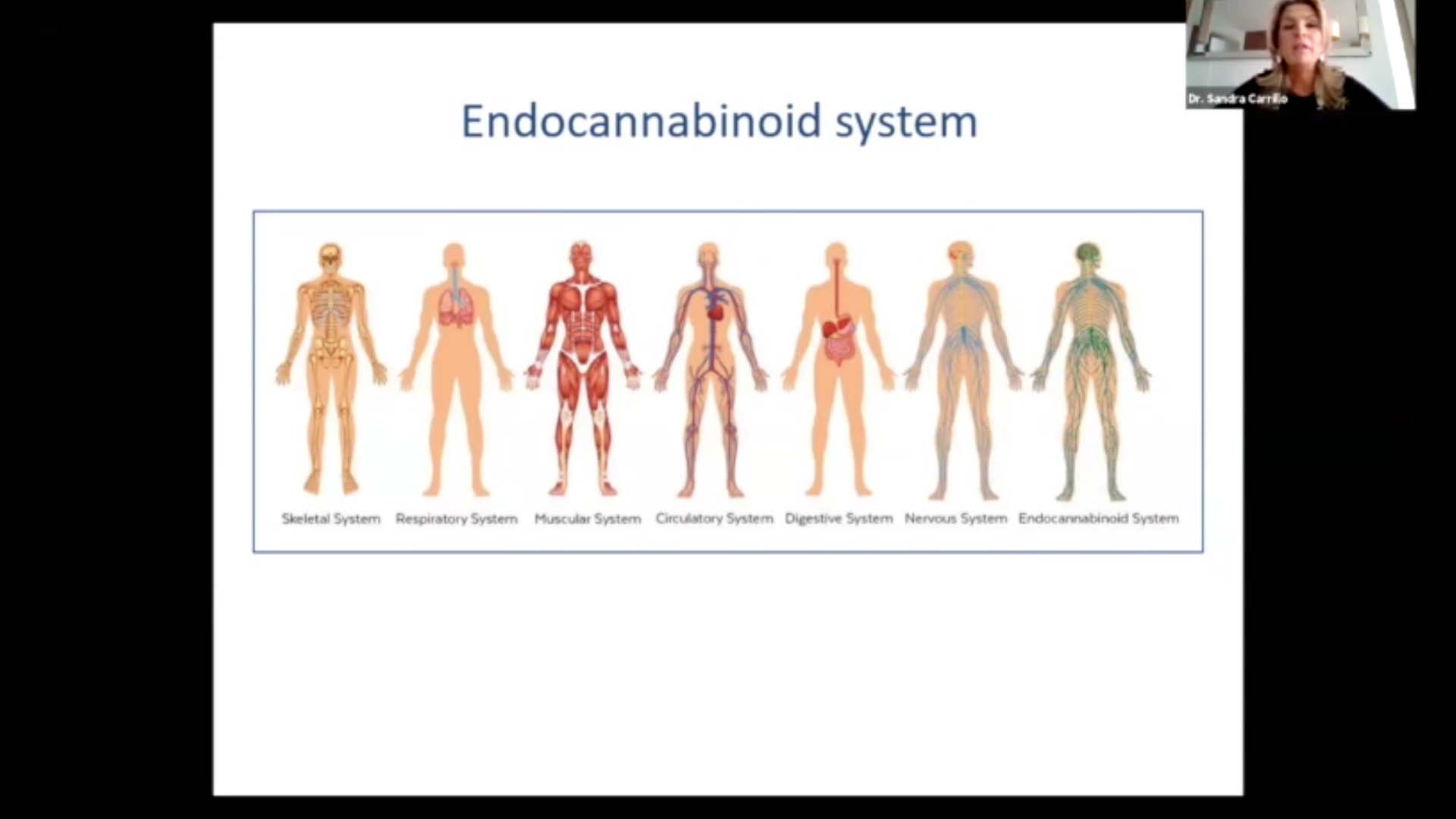
ECS is composed of cannabinoid receptors, endogenous cannabinoids like anandamide and 2-AG, and enzymes responsible for their synthesis and degradation. The ECS’s unique signaling mechanism operates on-demand and participates in diverse bodily systems, including the central nervous system, immune system, digestive system, muscles, hormones, and bones. I highlight the complex interactions between phytocannabinoids (plant-derived cannabinoids) such as THC and CBD, and the ECS receptors.
I give special attention to the therapeutic implications of targeting CB1 receptors, primarily found in the brain, and CB2 receptors, which are dominant in the immune system. I also introduce the concept of the “entourage effect,” where the combination of various cannabinoids, terpenoids, and other compounds synergize to amplify therapeutic benefits rather than relying on isolated cannabinoids. I discuss emerging research concerning the ECS’s role in neurological protection and immunomodulation, including possible impacts on conditions like chronic pain, inflammatory diseases, and even COVID-19 related cytokine storms.
Throughout my presentation, I emphasize the need for more scientific research, especially following recent regulatory shifts, and stress the importance of education for healthcare providers to ensure safe and effective patient access to medical cannabis. I advocate for a holistic approach to treatment, viewing patients as whole beings rather than isolated symptoms, and suggest that boosting the ECS through lifestyle interventions like diet, exercise, and meditation is a promising area for future exploration.
Highlights
- Medical cannabis has seen rapid progress in Colombia, with a growing patient focus.
- The endocannabinoid system regulates critical bodily functions including pain, mood, and immune response.
- CB1 receptors are concentrated in the brain, facilitating neurological effects; CB2 receptors modulate immune responses.
- Phytocannabinoids like THC and CBD interact with ECS receptors to produce therapeutic effects.
- The ECS operates ‘on-demand’ through endogenous cannabinoids like anandamide and 2-AG.
- The entourage effect highlights the importance of cannabinoid synergy rather than isolated compounds.
- Education of healthcare professionals is essential for safe and effective medical cannabis use.
Key Insights
- Patient-Centered Industry Advancement: The medical cannabis industry’s development in Colombia showcases the importance of a patient-driven approach. Regulatory progress, clinical practices, and cultivation standards are tools I use to maximize benefits for diverse patient populations. This reinforces my belief that medicine is not merely about the product but the holistic care and well-being of patients.
- Endocannabinoid System as a Master Regulator: The ECS is unique among bodily systems because it modulates a wide array of physiological functions essential for maintaining internal balance or homeostasis. Its involvement in sleep, appetite, immunity, inflammation, and mood underscores why cannabinoids can affect such diverse medical conditions. Understanding this broad regulatory role helps explain why medical cannabis can be effective across many disease states.
- Pharmacology of CB1 and CB2 Receptors: Deep knowledge of CB1 and CB2 receptor distribution is critical to tailoring treatments. CB1 receptors, most abundant in the brain, influence neurological processes, including motor control, cognition, and emotion, making cannabinoids useful in neurodegenerative and neuropsychiatric conditions. CB2 receptors, primarily in the immune system, mediate anti-inflammatory and immunomodulatory effects, which is vital in treating autoimmune diseases and inflammatory syndromes.
- On-Demand Signaling and Enzymatic Regulation: Unlike traditional neurotransmitters stored in vesicles, endocannabinoids like anandamide and 2-AG are synthesized and released on demand, reflecting a sophisticated and dynamic signaling system. Enzymes such as FAAH and MAGL regulate endocannabinoid levels by breaking them down, offering pharmaceutical targets for prolonging ECS activation. This enzymatic modulation opens a promising frontier for designing drugs that enhance endogenous cannabinoid signaling without introducing exogenous compounds.
- Entourage Effect and Cannabinoid Synergy: The concept of the entourage effect is pivotal in clinical cannabis application. It posits that the therapeutic benefits rely on the complex interplay between multiple cannabinoids, terpenes, and flavonoids from the plant rather than isolated THC or CBD alone. This insight challenges pharmaceutical models focused on single molecules and supports a holistic phytochemical approach to treatment design, emphasizing the need for full-spectrum products in some conditions.
- Clinical Endocannabinoid Deficiency (CED) and Disease: Dr. Ethan Russo’s theory of clinical endocannabinoid deficiency suggests that certain chronic illnesses—such as fibromyalgia, irritable bowel syndrome, and migraine—may arise from an imbalance or deficiency in endocannabinoid tone. Correcting this imbalance with cannabinoids could normalize function and relieve symptoms. This framework shifts the therapeutic strategy toward restoring ECS homeostasis instead of only symptom suppression.
- Future of Medical Cannabis Research and Practice: With regulatory changes gradually removing barriers to cannabis research, there is enormous potential for scientific discovery. Future studies may better characterize ECS involvement in diseases, refine cannabinoid formulations, and optimize dosing protocols. However, for patients to benefit fully, it is crucial to educate physicians, healthcare practitioners, and industry stakeholders about ECS science and cannabis pharmacology to promote evidence-based, safe, and effective medicine. I emphasize that education is the bridge to transforming the evolving scientific knowledge into routine clinical practice.
Conclusion
My lecture provides a detailed yet accessible exploration of the endocannabinoid system, illuminating its central role in health and disease and the therapeutic promise of medical cannabis. I tie together historical, biochemical, physiological, and clinical perspectives to build a comprehensive understanding of how cannabinoids and the ECS interact. My patient-centered approach and call for education and research highlight the importance of integrity and knowledge in advancing this promising field. This presentation serves as both an educational resource for clinicians and a foundation for future innovation in cannabinoid medicine.